
A Good Day To Die
On grenades and easter baskets and cold plunges and the way death can wake us up to life

Dear Ones –
We’re sitting at a café with friends, each of us drawing birds, when Freddi wonders why we call the Friday before Easter Good Friday.
If that is the day Jesus died, then why would it be considered good? He asks, shading the side of an AK-47 he has put into the hands of his bird.
We had just come from the Army-Navy surplus store where I had refused to buy him an East German WW2 era trench coast. Devastated not to have a memento from what he called “the best store he had ever been in,” he demanded that I at least buy him a grenade, since his friends were also getting them. An outspoken pacifist who also longs to be a good-natured mom on a 70- degree Spring Break day, I reluctantly agreed.
Apple or pineapple? the clerk asked cheerfully. She wore belted camo pants and a tucked-in black tank top. Thick eyeliner framed her eyes as she pulled out old bullets and metal shells to show the kids. Her hands shook each time, at odds with her chirpy demeanor. Freddi picked the pineapple-shaped grenade, and it now sits on the café table next to our drawings of eyeglasses and kites, mustaches and trees.
Good Friday is considered good, I say, adding blue to my bird’s wing, because the death of Jesus leads to life. No resurrection without death first.
Right, right, Freddi says, adding an army tank to his picture as well as flying shrapnel.
Frowning, I say, I thought we were drawing birds, and he looks at me with annoyance, pencils in a blast of firepower to the scene.
Earlier that morning he revealed that he wants to be an army engineer when he grows up so that he can build guns and bombs.
I don’t want to fight or anything, he said, trying to sound reassuring. I just want to do the technical stuff.
You do know what that technical stuff is used for, right? I said with an edge to my voice.
Sure, he said.
To kill people and destroy stuff, I added.
He nodded, smiling with excitement.
Like, innocent children and civilians and schools, I say, pressing my point. For greed, power and money. Is that what you want?
I’m 11! He said, exasperated.
Other parents echoed his exasperated response. Stop taking this so seriously, they said to me. He’s a prepubescent boy. Have some perspective. All boys go through this, this fascination with violence. But I couldn’t stop thinking about it, so disturbed by the image of my kid reveling in destruction, seduced into believing that it was somehow normal to fantasize about joining into and romanticizing this billion-dollar industry of war. I felt desperate to redirect the urge.
We gotta get you into more art classes! I said, and Freddi left the room, rolling his eyes.
Now, at the café, he draws melting, skeletal faces, sinister kites, and a mustachioed man with a word bubble that says, Up yo butt. My friends compliment him on his creativity while I look away, order another espresso and add sparkly stars to my mustache. No darkness here. No sir.
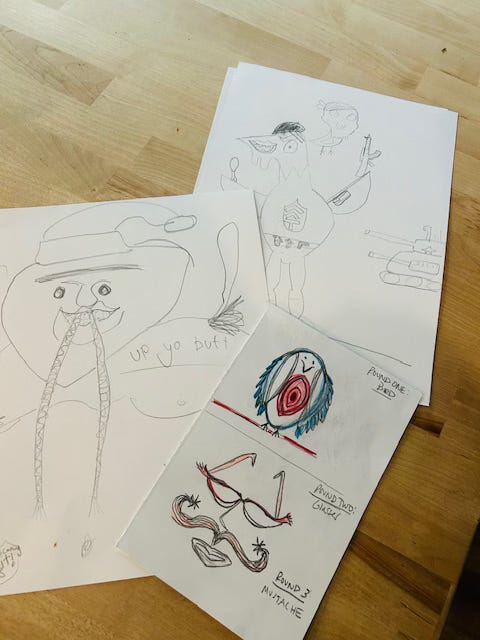
Doing my best to keep it light while my counterpart interrupts my plans.
*
The next day, at Good Friday service, the pastor reads the story of Jesus’s crucifixion from the Gospel of John. Between each devastating section – from the last supper where Jesus predicts his betrayal to the garden where he fervently asks for a different path through his bizarre trial with Pilate and until the moment he cries, It is finished! - the congregation sings the hymn O Sacred Head, Now Wounded.
Slowly, as we listen and sing, we become immersed in the dying. The goriness and the humiliation. The injustice and the shocking finality.
O sacred Head, now wounded,
With grief and shame weighed down,
Now scornfully surrounded
With thorns, thine only crown.
The readings describe Jesus’s betrayal by both his disciples and the wider community – those who lustfully and unapologetically demand the release of a criminal in exchange for his death – as well as the increasing visceral agony of the crucifixion itself. The thorns and the nails and the whippings. The thirst that is met with a vinegar- soaked sponge. The shuddering cry of a man abandoned and forsaken. The stab of a knife into flesh. The blood and water that pour out.
This is the story of a body and of unimaginable violence done to it. It is a brutal story, stunning in its intensity, and as a result most of us cannot really take it in. Instead, we look away, we water it down, soften it up, call it good and leave it at that. You’ve seen the sculptures and paintings, the crucified Christ depicted as sorrowful but also beautiful, serene and gorgeous. We don’t want to look, or else we do look and let the rage carry us away, diverting us from the heart. Who is to blame? Who is the true villain? Judas. The Pharisees. Pilate. The Romans. Peter, even, in his pathetic cowardice.
Unable to bear witness, we slide into an us vs. them dualism, a dividing knife that slices through rather than opens the heart, and this is, of course, the opposite of the non-dual path that Jesus taught and embodied, the path of unity and here-now presence. To question who is at fault is, in fact, the kind of question that leads to the crucifixion itself.
We need to stay grounded in the collective nature of what is meant by “He died for our sins,” writes the Episcopal priest and contemplative teacher Cynthia Bourgeault in her book The Wisdom Jesus.
The false self, she adds, is ultimately what crucified Jesus.
That self that is hungry to stay in control and on the surface of life, connected to the illusion of identity. The self that sparkles up the mustache, rages at an idea and looks away from the violence. The self that cannot bear witness to the darkness, but instead strives always to separate the good from the bad, the right from the wrong, to locate one’s self in one camp, to locate you in another.
Bourgeault describes how the main characters of holy week demonstrate an archetypal human struggle, one in which the false self - with its foundation of fear, greed, pretension, projection, self-importance - drives each dramatic action.
And in their collective mirror we can catch a glimpse of our own unacknowledged shadows, Bourgeault writes, our own patterns of inner doubt and darkness.
Who am I in the passion play? To which false self type do I tend to cling? And in that clinging, what darkness in myself do I avoid acknowledging, driving it down, deep into the shadows and instead unconsciously living in ways that are meant to uphold the image of myself that I love?
The righteous pacifist. The good-natured mom. The sparkly smiler.
As the Good Friday readings go on, Freddi lays his head on my shoulder. How much longer? he whispers, and when I tell him we’re not even to Judas’s troubling kiss, he sighs with boredom and exhaustion.
You’re just like the disciples who couldn’t stay awake while Jesus prayed, I joke.
Freddi acts offended and hisses, No I’m not! but I raise my eyebrows at him and whisper, Just wait till the cock crows three times.
He laughs, lays his head on my shoulder again, and I feel a mix of sorrow for my own seen and unseen patterns of division and also gratitude that I get to be an imperfect human in this imperfect world, supporting the head of my beloved, who himself has his own true self/false self divisions. How strange it all is, that this snuggly body – this sweet, soft hand resting trustfully on my own larger, weathered hand - also dreams of pulling a trigger, shooting a gun, and gripping a grenade? How strange that my love is unbounded for this human that came from my body and also that I get constantly tricked by fear-driven ideology – the kind that shuts down my heart and expresses itself in self-righteous lecturing.
Can I empty myself so that all that remains is love? What needs to die in me so that I can truly live, without division, without what is false?
Maybe the problem is that I take things too seriously, I say to my friends whose own kid shares similar destructive fantasies. Maybe I get too passionate and worked up about stuff. Probably I just need to just chill the heck out.
Or not, my friend says. Maybe you can just be the person you are and let that be. He shrugs. You’re the mom Freddi gets. What’s the problem?
The radical path - taught and lived by Jesus and at the heart of all mystical, non-dual traditions - is one of such mind-blowing, welcoming love that there is no requirement for bettering one’s self, there is no need to be different than one is. Knowing that - trusting that! - is, in fact, the way we enter this true path of Love. And in order to come into that knowledge we must admit that there is a split within us, a gap between our two selves. The false self and the true self. What we say we want and how we show up. What we choose and what is actually true underneath the sparkle and the mask.
When we acknowledge this split, we can, Bourgeault writes, fall all the way through the egoic operating system, with its inherent rigidity and fear, and into the fullness of love that can be known only in and through the heart.
In the fullness of love, there is no problem. In the fullness of love known in and through the heart and outside of ideology, we get to be the person we already are.
Messy. Grieving. Impatient. Scared. Too much. Not enough.
What a relief! For the moment I can bear that annihilating, blown-open kind of love, I let myself be. I let myself be held by those eyes of love, those eyes just below the crown of thorns.
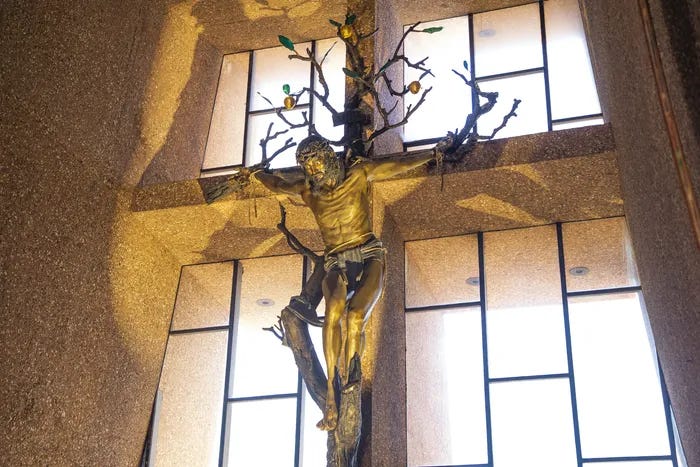
The crucifixion that hangs in the Chapel of the Holy Cross in Sedona, Arizona. Visitors can stand where Mary Magdalene and others stood, right at the foot of the cross, bearing witness to both the violence of this death and receiving the eyes of forgiveness and love.
**
On Friday night, I take my cousin Wendy to see Come See Me in the Good Light, a documentary about the poet Andrea Gibson’s last year of life as they and their partner Meg live with Andrea’s cancer. Just one year ago Wendy lost the love of her life to cancer, and while many in her situation would have avoided the emotional intensity that a movie like this might activate, Wendy is not most people. She is the kind of brave and open soul that wants to be in the presence of the real. And so, fortified with a delicious dinner, a strong cocktail, and a pile of Kleenexes, we settle into our seats and clutch hands.
Within minutes we are crying. Also, just as quickly, we are laughing.
The movie captures the tedium and profundity of illness, the power of death’s presence, and the simple, good light that shines in and through us when all is welcome. Death, the movie suggests, teaches us how to live. As we watch the unfolding love stories about Andrea and their partner, Andrea and their poetry, Andrea and their cancer, we see how the presence of death unwittingly short-circuits all attachments to identity, to that false, carefully cultivated self. We see how death can, if we let it, wake us up to, as Andrea calls it, a “bliss state”, a non-dual awareness rooted in radical presence, where all the old complaints and resentments and wounding floats away and what we are left with is the open sky mind of pure, self-emptied love.
There is no end to what is included in that love!
We see Andrea laughingly fix their always toppled country road mailbox. We see them spend hours making feeders for the yard’s squirrels. We see them shooting baskets in their driveway, entertaining ex-lovers turned best friends. We see them dancing, crying, scared, weak, strong, cradled and cradling, holding their dogs and their wife and their fans, saying again and again, in various ways, Death is not the end… it is a beginning… it is an entering into something beyond our wildest imaginations… is is the doorway to love.
Love is recklessness, not reason, writes Rumi.
Reason seeks a profit
Loves comes on strong, consuming herself, unabashed.
Love consumes itself until there is nothing left to cling to, get tripped up on, edged out by, or divided from.
Having died to self interest,
Love risks everything and asks for nothing.
Love gambles away every gift God bestows.
*
In the middle of Holy Saturday - the day of waiting, where death seems like the end and all of our dreams seem stupidly impossible and naively misguided - I realize I haven’t yet put together an Easter basket for Freddi. Usually, I do it with my sister-in-law, filling plastic eggs with jelly beans late into Saturday night, or with my sister when I’m out in the Catskills, arranging gourmet NYC treats and cute socks. Today, I feel uninspired and grumpy that I have to do it by myself. In a rush, I cruise around town gathering up beef jerky sticks, sweet drinks I would never normally buy, and bags of Freddi’s favorite candy – Bonbon’s sour elderflower gummies and Pippi Longstocking gold coins.
What else? I think, What else? And in some kind of haze, propelled by a force I’m not sure how to name, I find myself walking into GI Joe’s, the Army-Navy store, looking for the coat that had captured Freddi’s imagination. I comb through stacks of vintage sailor shirts, bomber jackets, and sniper coats, but it is nowhere to be found. Frustrated that it’s not here and confused that I’m even looking, I suddenly feel that it’s very important to surprise him with something he loves, something that really will light him up. I enlist the help of two employees - one of them a Christopher Walken look-alike who will not look me in the eyes - and turn the vintage section upside down. Wool sweaters, trench coats, leather jackets. Nothing! The jacket is gone! Running out of time and with no other ideas, I decide to just get him another grenade, the one with the apple shape.
As my credit card is processed, one part of me is like,Wwhat are you doing putting a grenade in your kid’s easter basket? and another part of me is like, Don’t worry, it’s just love. Don’t make a big deal out of it.
Which is true? Which is false? What part of me is buying this grenade for him?
I walk out into the sunshine, one block from my favorite plant store, and compelled by a force just as strong as what led me to the grenade, I beeline it towards the towering fig trees and generous stems of philodendron. Quickly, I pick out an on-sale orchid with supple purple blooms and a tiny two-stemmed Pellonia Pulchra, a watermelon vine that loves humidity and bright light. These are questionable commodities in my house, but I ignore that. At this moment balancing out the death grenade is all that matters.
Later that night, Freddi says, You better have bought me some Peeps, and I make a face of disgust. Careful, I say, You’ll be lucky to get a basket at all, and he makes an equally disgusted face back.
While he is asleep, I arrange the basket of gifts. The metal grenade sinks beneath the easter grass, leaning heavily into the small vine.
Well, I think. It is finished.
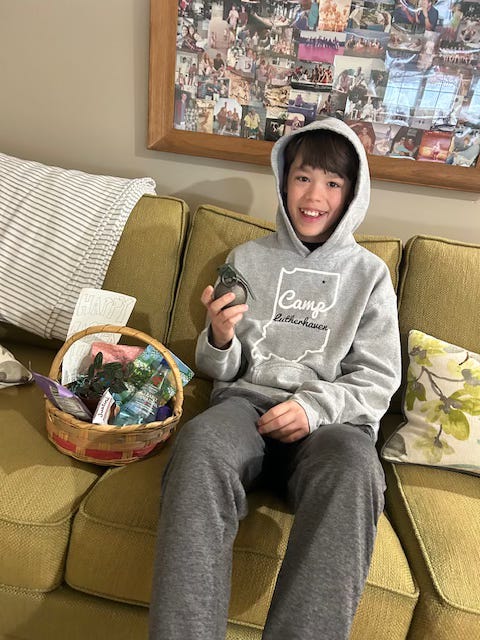
Just an 11 year old with some candy, a plant, and a defused grenade… and a receipt for more art classes!
*
Easter Sunday feels a little lonely this year without my brother and his family, but I am committed to following through with the annual cold plunge. I can’t remember how the tradition began but my brother Tom and my sister Julie and I have been doing it for at least eight or nine years. Wherever we are – New York, Indiana, Michigan – we find water to plunge into and from which to emerge, usually screaming, often laughing, always incredibly refreshed. We send each other videos – from the Huron River, the Stony Clove Creek, a neighbor’s pond, Lake James. One year there was still snow on the ground so we rolled ran through it barefoot and rolled several times instead. My dad joined that one, but he wore sneakers, so we’re not sure if it counts. He did roll though!
The idea, I guess, is to be brave, to choose to get uncomfortable, and to come out of the situation knowing we have gone through something, we have survived something hard, and we have been reborn.
This year it’s 21 degrees with the windchill, and the lake is white-capped and wild. The sky hangs low and heavy with clouds, and my dad keeps saying, I’m worried about you, Sara. You don’t have to do this.
Do I agree with him? Which part of me is choosing to do this anyway? Is the false self at work, trying to be tough, look good, seem impressive?
Yes, Freddi confirms, when I consider this out loud. That’s exactly what’s going on.
Thank goodness my 22-year-old cousin show ups to keep me focused. If Jesus could die on the cross with a crown of thorns shoved into his head then we can do this, she says, looking me in the eyes. And we can do it gratefully!
Good point, I say.
Our other cousin in Seattle calls to say she is riding her bike to the ocean and let’s time our plunges, so we agree, grateful to wait as long as possible. As we dig into mimosas and shrimp cocktail, charcuterie and spiced hummus, the conversation turns to mothers. The complaints we have about their imperfections and the shadows they never seem to notice in themselves. We also talk about children, how the mothers see them so clearly, but often remain conflicted. When do we step in to guide and confront and when do we leave them be? When do we offer a mirror and when do we let life teach them?
I already can’t remember the Easter message from that morning’s service – something about wearing new clothes and resurrection- but I do remember watching several young men kneel for communion. The backs of their t-shirts advertised their college baseball team and read, Proverbs 27:17.
As iron sharpens iron, my mom whispered, so one person sharpens another.
After the service, the baseball players stood around chatting, and my mom joined in, asking how the season was going, who played what position and if they had anywhere to go for Easter. They laughed politely, wondering who this woman was, and when she asked who the women were with them, one of them good-naturedly said, Cheerleaders. Everyone laughed a little, and they demurred when my mom invited them over.
I noticed that only one small part of me felt embarrassed by her bold, arguably nosy friendliness while in the past I would have joined Freddi and my dad as they slunk away to the car. This year, however, I could feel myself close to joining in, inviting them to the cold plunge, and I admired her unapologetic curiosity.
Can we ever choose to be different than we truly are? How does time spent on the path of self-emptying, forgiving love lead to transformation without us even noticing?
Over the years, I’ve forgiven my mom many times, and she, too, has forgiven me. Choosing to let go of deep hurt and wounds to our egos - staying near to one another - we are sharpened. We become more of ourselves. As we recognize and allow our differences to be as they are, not needing to understand it all and focusing instead on the love between us, the false self drops away. And it leaves our true natures sparkling.
Bourgeault describes the resurrection – in fact, the whole wisdom path of Jesus - as “a recognition drama,” one in which we are invited again and again to see - not with the eyes of our old story, that false self - but with eyes of the heart.
Blessed are the pure in heart, Jesus says in the Gospel of Matthew, for they will see God.
And how do we become pure of heart?
As soon as I got diagnosed, I had this experience, Andrea Gibson says in an interview on the podcast We Can Do Hard Things.
I’m going to try not to be shy about it, but it was a direct experience of the divine.
She explains that she felt herself genuinely surrender to the moment, exactly as it was. And it was not about giving up, she clarifies. In fact, she went into action, taking incredible care of her body, wanting to live. No, the surrender was about trusting.
Not my will, prays Jesus in the Garden of Gesthemene, but your will be done.
And as soon as I did that, Gibson says, it was like I caught this wave, and it was like they could no longer think of their challenge as NOT God. Everything became God, they say. As they saw God clearly, they felt constantly in a state of bliss, astonishment and awe.
The fact of my mortality was the seed of that bliss, they say.
How do we become pure of heart so that we can see God?
Not my will, but your will be done. Not my will, but your will be done. Not my will, but your will be done.
Like a blade being sharpened one side at a time, again and again and again, we surrender our false self fears and needs, our bitterness and ego-protective strategies. We welcome death and we let it lead to life. Many times in a day, many times in a life, we practice surrendering to that which is bigger than death. And in allowing our own shivering, tender vulnerability, we encounter God. Everywhere we look, we see. Astonishingly. Love. Love. Love.
How do we become pure of heart?
It’s simple, as they say, but not easy. Like leaping from the dock on a 21 degree day. Like allowing the Roman guards to capture your body. Like allowing your kid to have his dreams and ideas without you stomping all over them. Like putting down your bag of resentments, your story of what is right and what is wrong and what is possible and what is impossible and who is to blame and how things should go.
Like laughing and laughing as you come up out of the cold water and through the fear and into the towels of those who love you and into the warmth of the sunlight you hadn’t noticed through your worry.
Like emerging into bliss.
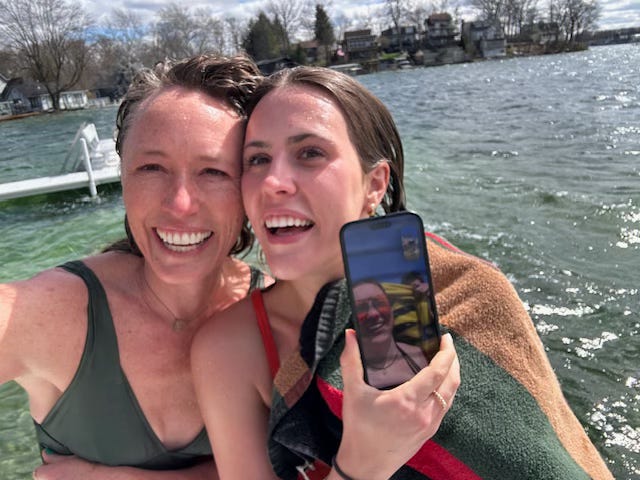
The joy after the plunge, celebrating with our cousin in Seattle. It’s always worth it!
*
A few days after Easter, my friend asks Freddi what he got in his basket. When Freddi tells him, he raises his eyebrows in surprise.
Does your mom like grenades? he asks, and Freddi laughs instantly, saying, Not at all!
Then why did she get one for you? asks my friend.
Because she loves me, says Freddi simply. Because she really, really loves me.
I breathe and take in the pure eyes of his heart. Defused, like the grenades themselves, my complicated feelings about Freddi’s interest in weapons dissolve in the presence of all that love. And all that remains is God.
The two grenades sit on Freddi’s desk now, and while I still feel weird about having them in the house, here they are. Reminders of the power of death. Reminders, too, that Love is always bigger. That through death, we emerge into life.
Attempting to bear witness to all that is here, acknowledging the inner conflicts and intense feelings, the clinging to old stories that I hope will keep me safe but actually keep me from seeing and knowing God, I am here, caring for that little watermelon vine as well as not looking away from the grenades, in dying and living, dying and living, not my will but yours, bowing to the power of death that opens me into bliss beyond words,
Love, Sara
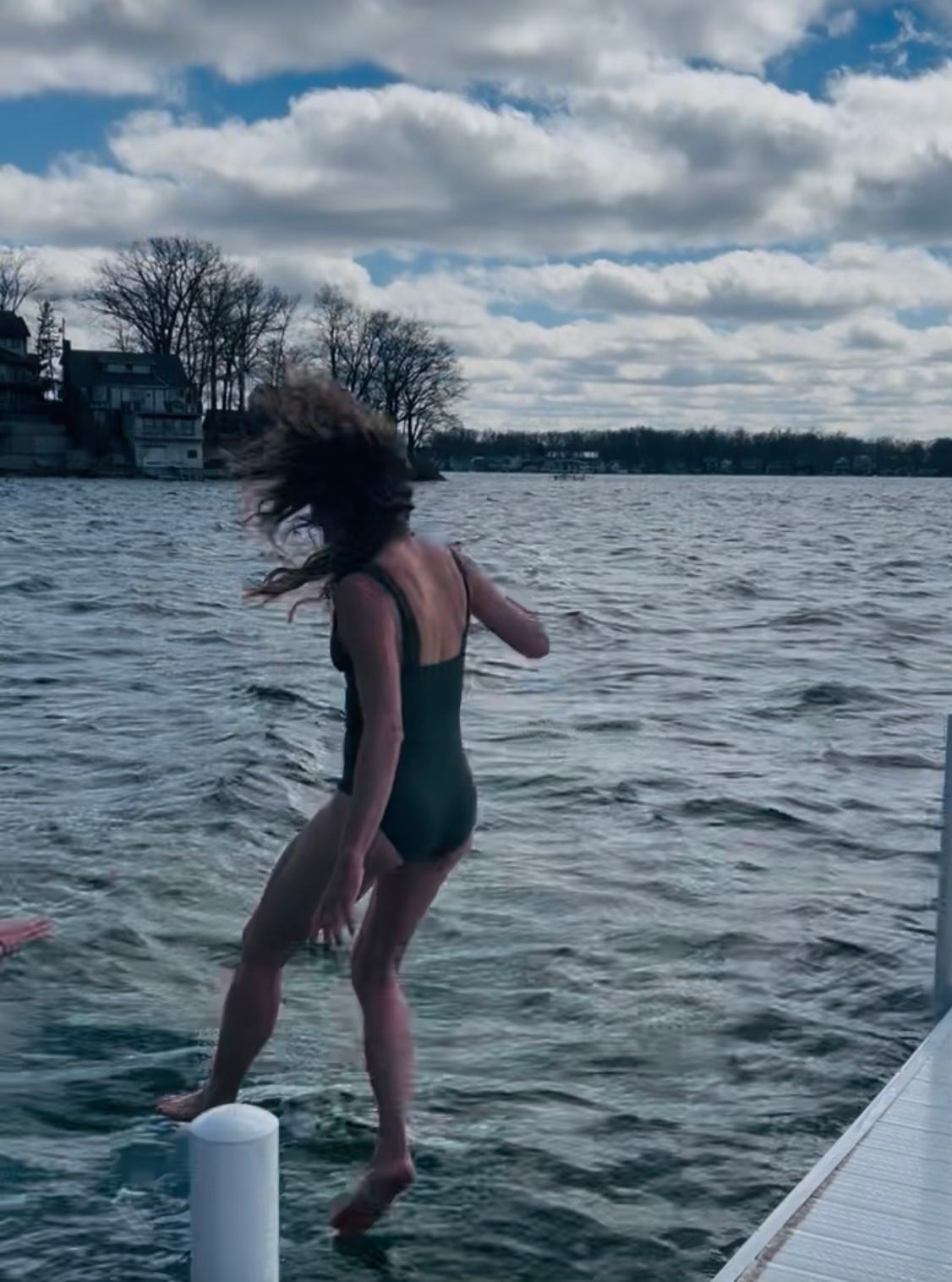
Surrendering and trusting, so that maybe one day, if only I can keep the eyes of my heart open, seeing God, I will walk on water!
WORK WITH ME:
Join me for online yoga and meditation classes every Saturday morning and Tuesday morning! Join me for online Yoga Nidra meditations on the new and full moons! Join me for one-on-one ministry of presence coaching and life transformation work! I’d love to connect!